
Which Automakers Had the Most Safety Recalls?
Written by Staff Writer | Edited by Joey Rosenberg
Vehicle recalls are often judged by the biggest number: how many vehicles are affected. But recall size does not always tell the full safety story.
A recall affecting millions of vehicles may involve a narrowly defined issue discovered through compliance testing. A much smaller recall may involve a defect that creates a more immediate risk, such as a possible fire, loss of braking ability, steering failure or unexpected loss of power.
To better understand recent recall activity, SafeMotorist analyzed National Highway Traffic Safety Administration (NHTSA) recall campaigns in a 16-month period between January 2025 and April 2026. Our analysis compares major automotive manufacturers by total recall campaigns, serious mechanical hazards and urgent owner advisories.
Key Takeaways
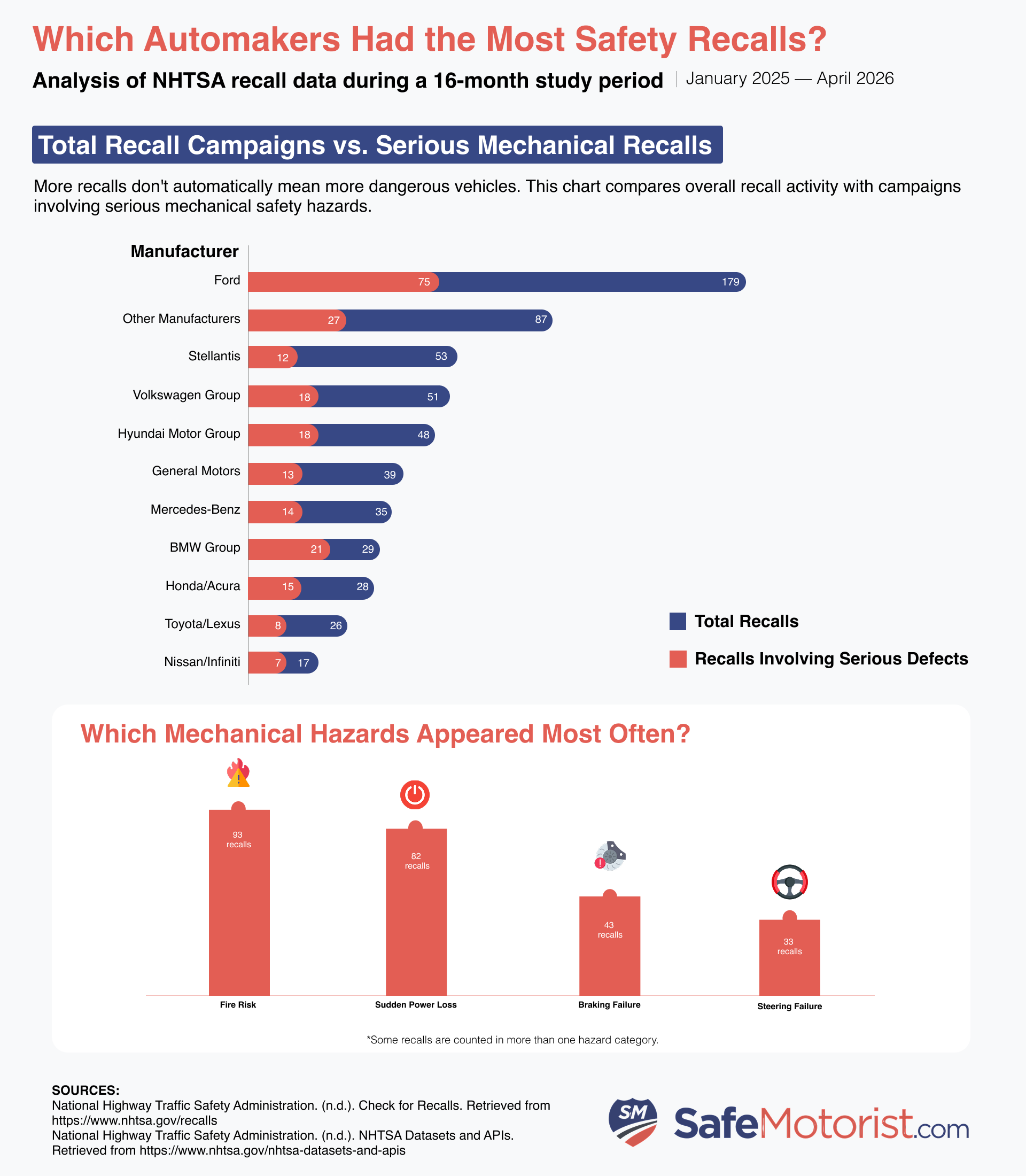
- Ford recorded the most recall campaigns during the study period, with 179 total campaigns and 75 involving serious mechanical hazards.
- BMW Group had the highest percentage of campaigns involving serious defects among the named manufacturers: 21 of 29, or 72%.
- Fire risk was identified in 93 campaigns, followed by sudden power loss in 82, braking failure in 43 and steering failure in 33.
- Recall size did not always reflect urgency. Some smaller campaigns carried “Do Not Drive” or “Park Outside” warnings because of immediate braking, airbag or fire hazards.
Which Automakers Had the Most Recall Campaigns?
The manufacturers with the highest recall activity during the study period were Ford, Stellantis and Volkswagen.
The data breaks down as follows:
Manufacturer | Total Recalls | Recalls Involving Serious Defects | Percentage of Recalls Involving Serious Defects |
Ford | 179 | 75 | 42% |
Other Manufacturers | 87 | 27 | 31% |
Stellantis | 53 | 12 | 23% |
Volkswagen Group | 51 | 18 | 35% |
Hyundai Motor Group | 48 | 18 | 38% |
General Motors | 39 | 13 | 33% |
Mercedes-Benz | 35 | 14 | 40% |
BMW Group | 29 | 21 | 72% |
Honda/Acura | 28 | 15 | 54% |
Toyota/Lexus | 26 | 8 | 31% |
Nissan/Infiniti | 17 | 7 | 41% |
Ford recorded the highest recall volume in the analysis, with 179 campaigns and 75 campaigns involving serious mechanical hazards.
The manufacturer also recorded the highest number of campaigns involving:
- Sudden power loss (31 campaigns)
- Fire risk (25 campaigns)
However, recall volume alone should not be interpreted as a measure of overall vehicle safety. Larger manufacturers, larger fleets and differences in reporting practices can all influence recall totals.
What Types of Serious Defects Appeared Most Often?
Among the serious recall categories reviewed, the most common hazards were fire risk, sudden power loss, braking failure and steering failure.
Fire Risk: 93 Recalls
These recalls involved potential ignition sources such as fuel leaks, electrical shorts, overheating components or battery-related failures.
Sudden Power Loss: 82 Recalls
These recalls involved conditions that could cause engine stalls, propulsion shutdowns, loss of drive power or failure to restart.
Braking Failure: 43 Recalls
These recalls involved defects affecting braking performance, including issues involving pedals, pressure systems, hoses, fluid, boosters, calipers or stopping distance.
Steering Failure: 33 Recalls
These recalls involved possible loss of steering control, steering-assist failures, fractured components or increased steering difficulty.
Because a single recall campaign may involve multiple hazards, these categories overlap and should not be added together.
Recalls That Defined the Period
The largest recalls were not always the most urgent. Several campaigns illustrate the difference between recall size and safety severity.
Ford's 4.38 Million Vehicle Recall Was the Largest Campaign
In February 2026, Ford recalled 4,381,878 vehicles because connected trailer lights or brakes could fail to function properly.
The campaign affected more vehicles than any other individual recall reviewed in the analysis.
However, its risk profile was different from recalls involving immediate fire or crash hazards.
General Motors' Engine Failure Recall Had One of the Largest Incident Records
General Motors (GM) recalled 597,630 vehicles in April 2025 because certain 6.2-liter V8 engines could fail, creating a risk of sudden loss of power.
GM's filing included thousands of potentially related complaints and incidents, making it one of the most closely watched campaigns in the study period.
Jeep Plug-In Hybrid Recall Included a “Park Outside” Warning
In October 2025, Stellantis recalled 320,065 Jeep Wrangler 4xe and Grand Cherokee 4xe vehicles because a high-voltage battery defect could create a fire risk.
Owners were instructed to park vehicles outside and away from structures until repairs were completed.
Ford Recall Warned of Complete Brake Loss
A February 2026 Ford recall affected 15,965 vehicles but carried a “Do Not Drive” advisory.
The reason: The defect could result in a complete loss of braking function.
Although the recall affected far fewer vehicles than many other campaigns, the potential consequences made it one of the most urgent recalls reviewed.
BMW Airbag Recall Affected Fewer Vehicles but Carried the Strongest Warning
BMW recalled 5,361 vehicles in October 2025 because a driver airbag inflator could rupture and send metal fragments into the cabin.
The recall included a “Do Not Drive” warning because of the potential for serious occupant injury.
What Recall Numbers Mean for Drivers
Vehicle recalls are an important part of the automotive safety system, but the biggest recall headlines don't always tell the whole story. Looking beyond the number of vehicles affected can help drivers better understand the nature of a defect, whether a recall requires immediate action and what questions to ask when researching a vehicle.
Methodology: This analysis uses NHTSA recall data received January 2025–April 2026. Recall totals are campaign counts, not defect rates, reliability scores or measures of vehicle quality.
About SafeMotorist: A leader in state-approved online driver safety and driver education courses, SafeMotorist offers a variety of resources to help people build safer driving habits, including defensive driving classes and commercial driving training courses.
Sources:
National Highway Traffic Safety Administration. (n.d.). Check for Recalls. Retrieved from https://www.nhtsa.gov/recalls
National Highway Traffic Safety Administration. (n.d.). NHTSA Datasets and APIs. Retrieved from https://www.nhtsa.gov/nhtsa-datasets-and-apis