
Motorcycle Licensing Process: Passing Knowledge and Road Skills Tests for DMV Issuance
Written by Staff Writer
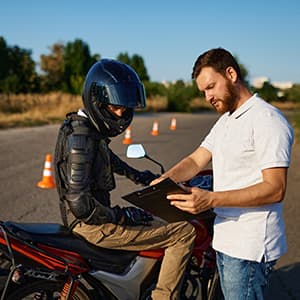
Obtaining a motorcycle license or endorsement typically requires a knowledge test and either a riding skills test or an approved safety course. Depending on the state, completing the course may allow an applicant to waive the DMV skills test.
Minimum Age Requirement for Motorcycle License
Minimum-age requirements vary by state and by license type. Some states offer restricted learner’s permits to younger applicants, while an unrestricted motorcycle license or endorsement may have a higher minimum age.
Younger applicants may also face additional requirements, such as parental consent, driver education or a minimum permit-holding period. Check your state DMV’s current rules before applying.
Applicants generally need proof of identity and residency and must satisfy the state’s testing or training requirements.
How State Requirements Affect Motorcycle Licensing
Your location affects the motorcycle licensing process. Consider these key factors:
- Check the minimum age requirement for a motorcycle license in your state.
- Complete a riding skills test or safety course for motorcycle license if required.
- Gather necessary documents, including your current driver's license and proof of residency.
- Pay licensing fees at the local motorcycle license office, which vary by state.
- Understand if your state requires a motorcycle endorsement on your existing driver's license.
- Research local regulations, such as helmet laws and riding restrictions.
- Verify the availability of motorcycle safety courses in your area to simplify the process.
Pro-Tip: Many people worry about passing the motorcycle test without their own bike. You can rent a motorcycle from local training schools or test centers.
Ask if they offer practice sessions with the same model used in the test. This helps you get comfortable with the controls and handling. Schedule extra practice time to build muscle memory and confidence. Focus on slow-speed maneuvers, braking and turns.
If you feel nervous, practice the test route if possible. Arrive early on test day to get familiar with the bike. Deep breathing and positive self-talk can help calm nerves before you start.
Applying for Endorsement With Required Documents for Motorcycle License
To apply for a motorcycle endorsement, you need specific documents. Typically, you must provide your current driver's license, proof of identity and residency. Some states may also require a motorcycle learner's permit. Completing a motorcycle safety course can simplify the process and may waive the riding skills test. Always check your local DMV for exact requirements, as they can vary by state.
Document Type | Requirement | Notes |
Driver's License | Must be valid | Required for all applicants |
Proof of Identity | Birth certificate or passport | Must be government-issued |
Proof of Residency | Utility bill or lease | Must show current address |
Motorcycle Learner's Permit | May be required | Check state-specific rules |
Safety Course Completion | Optional but recommended | Can waive skills test in many states |
Paying Licensing Fees for Motorcycle License
Motorcycle licensing costs vary by state. Applicants may pay separate fees for a learner’s permit, knowledge test, skills test, license or motorcycle endorsement.
Safety-course tuition is generally separate from DMV fees. Check your state DMV’s current fee schedule and the course provider’s pricing before applying. Also review refund and retesting policies, since these vary by agency and provider.
Typical Costs for Motorcycle License
While costs vary by location and provider, most riders can expect to pay between $100 and $500 for a state-approved motorcycle safety course. Beyond training fees, you should budget an additional $15 to $50 for the state DMV administrative fee to officially add the motorcycle endorsement to your license.
While state DMV endorsement fees typically range from $15 to $50, the realistic total cost for most riders—including learner's permits, safety courses and testing fees—is between $150 and $400.
The standard MSF Basic RiderCourse typically requires approximately 16 hours of total time, combining roughly 5 hours of online instruction with 11 hours of hands-on range training. Most state motorcycle knowledge exams require a minimum passing score of 80% to qualify for a learner's permit or endorsement.
Historical data suggests that applicants attempting the motorcycle skills test directly at the DMV face an estimated failure rate of 15% to 18%. Research indicates that 36% of motorcycle riders involved in fatal crashes in 2020 were riding without a valid motorcycle license, a significantly higher rate than that of unlicensed passenger vehicle drivers.